If you are looking for strength training for cyclists over 40, there is a good chance riding alone is not solving the whole problem anymore.
You may still love being on the bike. Maybe you ride pavement, gravel, trainer miles, or hill routes around Duluth. Maybe you still care about speed. Maybe you mostly care about feeling strong enough that rides do not beat you up for two days afterward. Either way, something usually starts to change after 40. Recovery is a little less automatic. Low back tightness gets louder. Hips feel uneven. Sprint power fades first. Long rides can still happen, but your body starts asking for more support.
That does not mean you need to train like a bodybuilder.
It means good strength training for cyclists over 40 becomes one of the most useful ways to stay durable, preserve muscle, improve force production, and keep your riding fun instead of fragile. If you want the wider picture too, it helps to read strength training for runners over 40, functional training for metabolic health, zone 2 training for beginners over 40, and workout recovery over 40.
Why strength training for cyclists over 40 matters more than it used to
Cycling is great for your heart, your mood, and your aerobic engine.
It is not enough by itself to fully protect muscle mass, bone density, tendon capacity, and the kind of force production that tends to fade with age. That is especially true for cyclists who spend a lot of time in the same positions, hammer the same tissues, and assume more riding will fix every weakness.
It usually does not.
Research and coaching articles ranking for this topic keep coming back to the same themes. The Roadman Cycling pieces emphasize fast-twitch loss, tendon resilience, and rate of force development. CycleCoach puts more focus on recovery structure, durability, and long-term performance. Simple Endurance Coaching leans into bone density, injury reduction, and classic lifts. Those are all useful.
The gap is that a lot of those articles are written for performance-minded riders, not for normal adults trying to ride well without getting hurt. Some are also more coach-centered than patient-centered. They explain training theory, but not always how to fit strength work into a body that is already tired, stiff, or inconsistent.
That is where a more practical approach helps.
What cyclists over 40 usually need most
Most cyclists do not need random circuits, endless core work, or leg-day workouts that leave them useless on the bike.
They usually need:
- stronger glutes and hamstrings
- better single-leg control
- more trunk stability
- stronger upper back and shoulders for posture
- enough leg strength to support climbing, sprinting, and fatigue resistance
- tendon and joint capacity that keeps small problems from becoming chronic ones
That is why the best strength training for cyclists over 40 is usually simple on paper. The value is not in novelty. It is in doing the right patterns consistently.
The biggest mistakes cyclists make in the gym
Doing conditioning and calling it strength
High-rep circuits with light weights can make you sweat. They do not always build much strength.
If every set feels like cardio, you may be training your lungs more than the tissues that actually need support.
Copying younger riders or advanced lifters
Heavy barbell programs can work for some cyclists, but not every rider over 40 needs to chase them. If your hips are stiff, your back gets cranky, and you have not lifted consistently in years, there is no prize for choosing the most aggressive setup possible.
Lifting so hard it ruins the bike work
The goal is better riding, not gym domination.
If strength sessions leave you too sore to pedal well for half the week, the plan needs work.
Ignoring recovery and protein
This shows up constantly. People add riding, add lifting, keep life stress high, eat like nothing changed, and then wonder why everything feels harder.
If you are under-recovered or under-fueled, good programming still struggles.
The best movement patterns for strength training for cyclists over 40
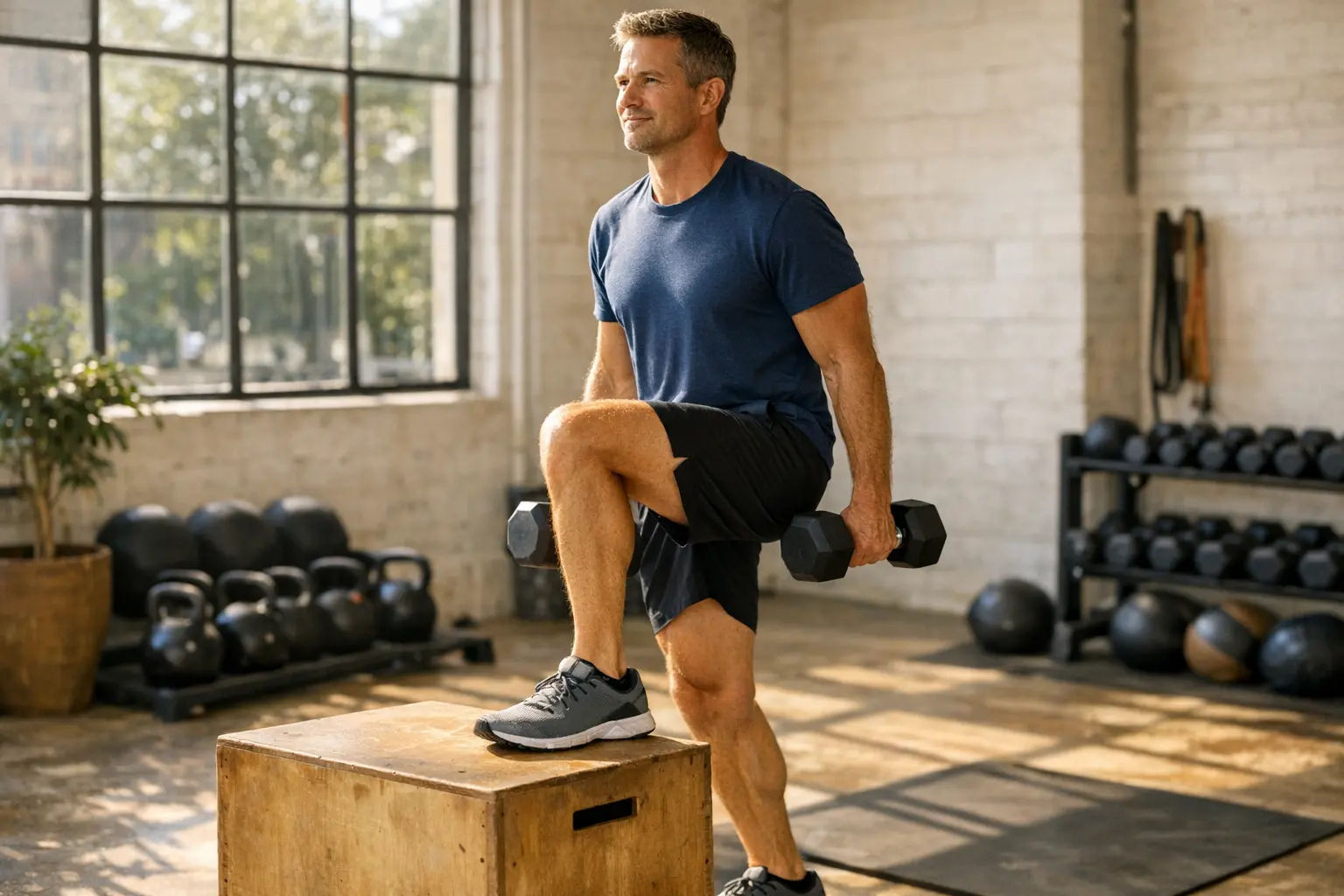
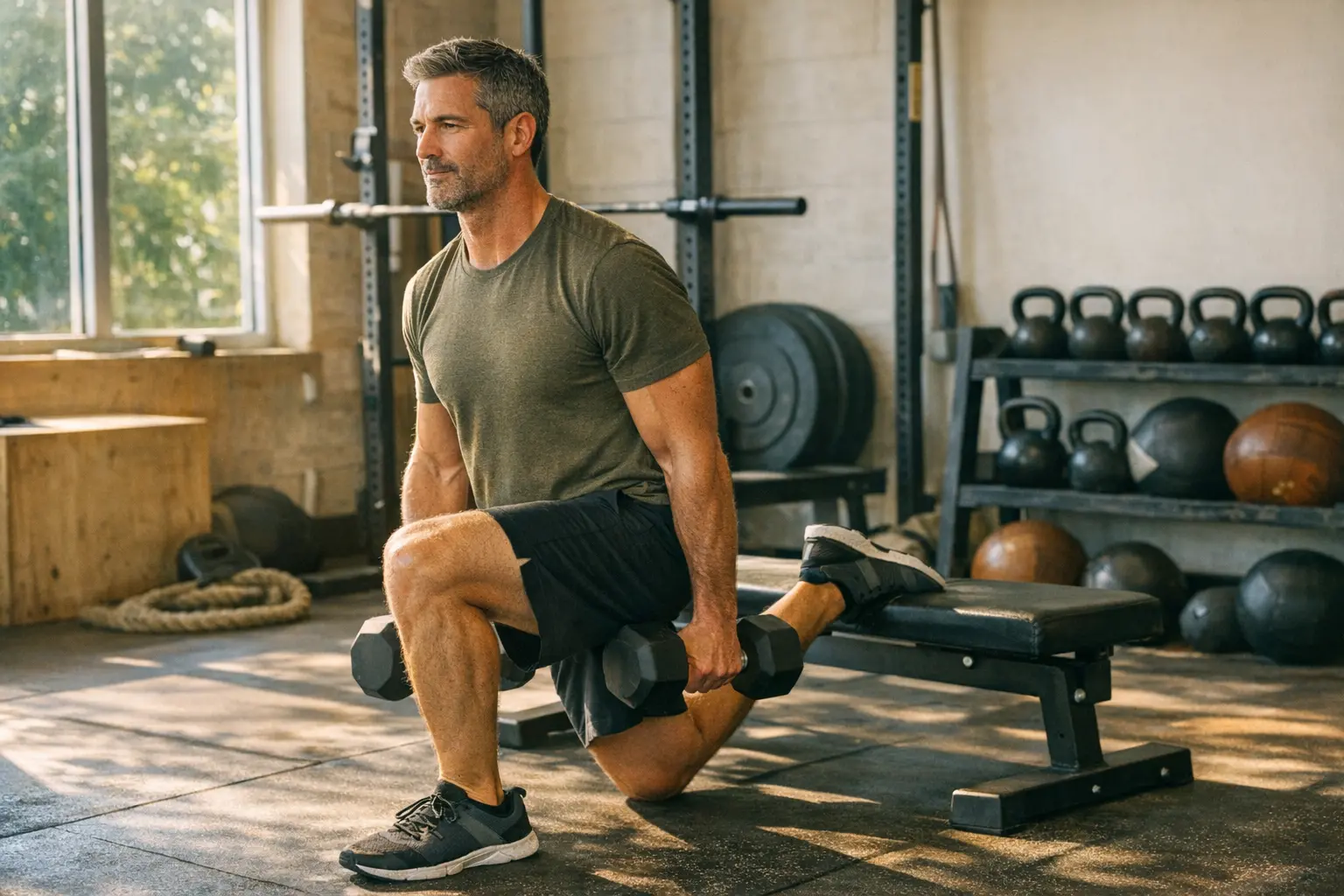
Split squats and step-ups
Cycling is a one-leg-at-a-time sport, even though both feet stay clipped in.
Split squats, step-ups, and reverse lunges build single-leg strength, expose side-to-side differences, and help with hip control that the bike can hide.
Hip hinges
Romanian deadlifts, kettlebell deadlifts, and single-leg hinge patterns help wake up the posterior chain. A lot of cyclists are quad-dominant and underuse their glutes. Hinge work helps fix that.
Squat patterns you can own
Goblet squats, front-loaded squats, or controlled box squats can build strength without forcing everyone into a barbell back squat they are not ready for.
Core stability and carries
You do not need circus-core workouts. You need a trunk that stays steady while your legs produce force. Carries, planks, dead bugs, and anti-rotation work usually do that better than endless crunches.
Upper-body pulling and pushing
Rows, push-ups, presses, and band work matter more than cyclists often expect. A stronger upper back helps posture, shoulder comfort, and staying more stable late in long rides.
A simple weekly strength training plan for cyclists over 40
Most adults do well with two strength sessions per week.
That is enough to matter without taking over your whole training week.
If you are riding three to five days per week, place strength sessions after easier rides, after interval days if you tolerate that well, or on separate days where recovery is still manageable. The main idea is to avoid turning every day into a moderately hard day.
Day 1: lower-body strength and trunk work
Try:
- goblet squat or split squat, 3 sets of 5 to 8
- Romanian deadlift or kettlebell deadlift, 3 sets of 5 to 8
- step-up, 2 to 3 sets of 6 to 8 per side
- front plank or dead bug, 2 to 3 sets
- loaded carry, 2 to 4 rounds
Day 2: single-leg strength, upper body, and posture
Try:
- reverse lunge or split squat variation, 3 sets of 5 to 8 per side
- single-leg Romanian deadlift, 2 to 3 sets of 6 to 8 per side
- row variation, 3 sets of 8 to 10
- push-up or dumbbell press, 3 sets of 6 to 10
- side plank or anti-rotation press, 2 to 3 sets
That is enough for a lot of riders.
What about power work?
This is one place where stronger competitor articles are right.
Older cyclists often lose the ability to produce force quickly before they lose endurance. That means some explosive work can help, if your joints and movement quality are ready for it.
Examples include:
- fast step-ups
- medicine ball slams
- controlled jump squats
- light push presses
The point is not to turn every gym day into a plyometric workout. It is to keep some speed in the system.
If you are new to lifting, build the strength base first.
How hard should strength training for cyclists over 40 feel?
Hard enough to matter. Controlled enough to recover from.
That usually means finishing most work sets feeling like you had one to three good reps left. You do not need to grind to failure. You do need enough load to send a real signal.
A good starting point is moderate reps with steady progression. Once your form is solid, gradually increase load, not just volume.
If you are carrying a lot of fatigue already, scale back before you quit entirely. A shorter useful session beats a heroic plan you cannot repeat.
Strength training for cyclists over 40 and metabolic health
This matters beyond performance.
Muscle mass supports insulin sensitivity, blood sugar control, bone health, and long-term physical function. That means strength work is not only about watts. It is also part of staying healthy as you age.
For riders dealing with weight management, musculoskeletal weakness, or osteoporosis, a smart strength plan can support much more than the bike.
It also pairs well with exercise therapy, especially if old injuries, back pain, knee pain, or repeated overuse problems keep interrupting your momentum.
FAQ
How often should cyclists over 40 strength train?
For most people, two sessions per week is enough to build and maintain meaningful strength without overwhelming recovery.
Should cyclists over 40 lift heavy?
Usually yes, eventually, but within movements you can do well. “Heavy” is relative. The goal is meaningful resistance with good form, not reckless maxing out.
Will strength training make my legs too tired to ride?
It can if programming is poor. Done well, strength work should support riding, not bury it. Keep volume reasonable and avoid turning every session into a soreness contest.
Is cycling alone enough exercise after 40?
Cycling is excellent, but it does not fully cover muscle mass, bone density, and tissue resilience. That is why strength work becomes more important over time.
What if I have back pain or knee pain already?
That is exactly when exercise selection matters. You may need regressions, coaching, or a more personalized plan instead of copying a generic gym program.
The goal is not more punishment, it is better riding
Good strength training for cyclists over 40 should help you feel stronger on climbs, steadier on long rides, and less likely to fall apart when life or training gets busy.
It does not need to be flashy. It needs to be repeatable.
If you want help building a strength plan that fits your body, your history, and your metabolic health goals, contact Duluth Metabolic. We can help you combine training, recovery, and nutrition in a way that actually supports the life you want to keep living.