A good dumbbell workout for beginners over 40 should make you feel more capable, not beat up and discouraged.
That sounds obvious, but a lot of people over 40 have already had one of two bad experiences. Either they tried to get back into lifting and overdid it in week one, or they got stuck with such watered-down exercise advice that nothing ever changed. Neither one helps.
Dumbbells are a great middle ground. They are accessible, scalable, and useful whether you train at home, at a gym, or in a quiet corner of the garage while the rest of the house wakes up. You do not need a giant setup. You need a handful of movements that make sense, a weight you can control, and a plan you can repeat.
At Duluth Metabolic, we like dumbbell training because it can build strength, muscle, balance, confidence, and better metabolic health without requiring complicated programming. That matters for adults dealing with low energy, old aches, musculoskeletal weakness, early bone loss, or the feeling that their body has become unreliable.
If you want more context around this style of training, start with functional training for beginners over 40, full-body strength workout for beginners over 40, and strength training plan for busy adults over 40. This article is the dumbbell-specific version.
Why dumbbells work so well after 40
Dumbbells are simple, but they ask your body to do real work.
You have to control the weight on both sides. You have to stabilize through your core. You have to move through a usable range of motion instead of relying on a machine path to do the organizing for you. That makes dumbbells incredibly practical for everyday strength.
They are also easier on a lot of joints than people expect. You can change your hand position, shorten the range if needed, and choose movements that fit your body instead of forcing your body into one exact setup.
That matters after 40, when people often need a little more flexibility around shoulders, knees, back history, balance, and recovery.
A sensible dumbbell workout for beginners over 40 can help with:
- muscle mass and strength
- insulin sensitivity and blood sugar control
- bone loading and long-term resilience
- posture and balance
- confidence with everyday movement
- energy and mood
That is a big return from a small piece of equipment.
The biggest beginner mistake
Most beginners do not fail because dumbbells are too basic.
They fail because they make the workout harder than it needs to be.
Too many exercises. Too much weight. Too little rest. Too much soreness. Too much “I used to be able to do this” energy.
The better move is to train in a way that leaves you wanting to come back in two days. Progress over 40 is rarely about one heroic session. It is about stacking enough good weeks that your body has a reason to adapt.
What a good dumbbell workout for beginners over 40 should include
A strong beginner plan usually covers the main movement patterns without trying to win a fitness contest.
A squat pattern
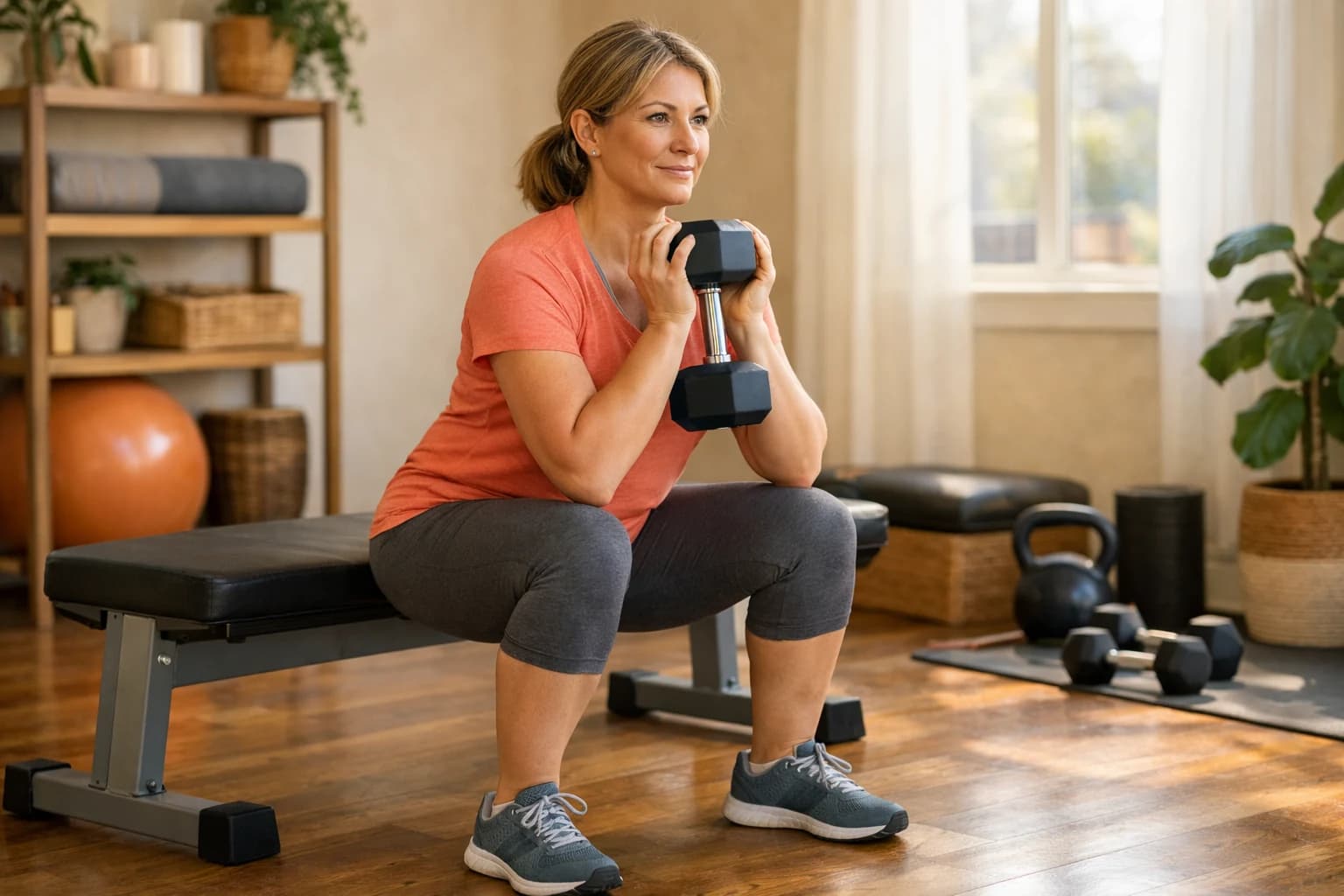
This teaches your legs and hips to work together. Goblet squats, box squats, and sit-to-stands with a dumbbell are all solid options.
A hinge pattern
This is how you train the back side of the body. Dumbbell Romanian deadlifts are a great place to start because they teach hip movement and glute tension without needing a barbell setup.
A push
Think incline push-ups, dumbbell floor presses, or seated dumbbell presses. The right choice depends on shoulders, confidence, and available space.
A pull
Rows matter a lot. They help with posture, upper back strength, and the general feeling that your body is not collapsing forward all day.
A carry or core movement
Farmer carries, suitcase carries, and simple core work help build the kind of strength people actually use in daily life.
A simple dumbbell workout for beginners over 40
Start with two or three sessions per week. Leave at least one day between strength workouts at first. Keep the pace calm. Rest enough to feel ready for the next set.
Warm-up for 5 to 8 minutes
Do not overthink this. Walk a bit, march in place, do some shoulder circles, bodyweight squats to a chair, and a few easy hip hinges. The point is to feel less stiff, not to get tired.
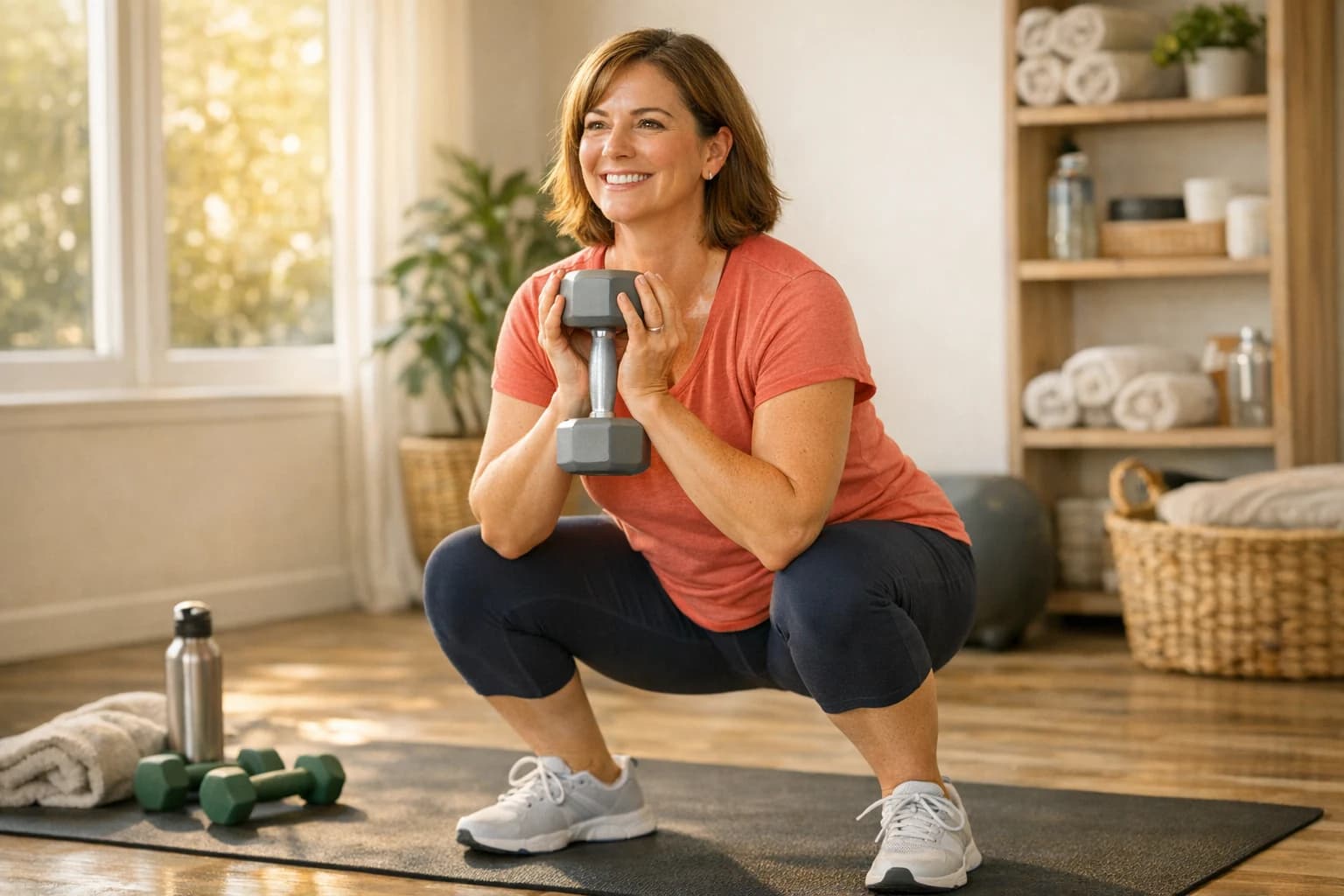
1. Goblet squat
Hold one dumbbell at chest height.
Do 3 sets of 6 to 10 reps.
Sit down between your hips, keep your chest tall, and use a depth you can control. If full-depth squats feel sketchy, squat to a box, bench, or chair.
2. Dumbbell Romanian deadlift
Hold one or two dumbbells in front of your thighs.
Do 3 sets of 8 to 10 reps.
Push the hips back, keep the weights close to the legs, and stop before your back starts rounding. You should feel hamstrings and glutes more than your low back.
3. One-arm dumbbell row
Support yourself with your free hand on a bench, chair, or sturdy surface.
Do 3 sets of 8 to 12 reps per side.
Pull the elbow toward your hip, not straight up into your shoulder. Think strong back, quiet neck.
4. Dumbbell floor press
Lie on the floor with knees bent and a dumbbell in each hand.
Do 3 sets of 8 to 10 reps.
This is a great beginner pressing option because the floor limits the range a bit and helps many people feel more stable than a full bench press.
5. Suitcase carry
Hold one dumbbell at your side and walk slowly.
Do 2 to 3 rounds of 20 to 40 seconds per side.
This is one of the simplest ways to train grip, trunk stability, and real-world strength.
6. Optional finisher
If you still feel good, finish with 5 to 10 minutes of easy walking, bike work, or marching in place. You do not need to crawl off the floor for the workout to count.
How heavy should the dumbbells be?
A good beginner weight lets you finish the set with solid form while still feeling like the last couple reps took effort.
If you could do fifteen more reps, it is probably too light. If your form breaks halfway through, it is too heavy.
For many beginners, that means starting lighter than the ego wants and progressing faster than expected once technique settles in.
It is completely fine to use different weights for different exercises. Most people can row more than they can press overhead. Most people can deadlift more than they can curl. That is normal.
How to progress without getting wrecked
You do not need a complicated spreadsheet.
Progress one variable at a time.
Add a rep before you add a lot of weight. Add a little weight before you add extra exercises. Add a third weekly session only after two sessions feel normal.
A simple example:
- Week 1: 3 sets of 6
- Week 2: 3 sets of 7
- Week 3: 3 sets of 8
- Week 4: add a little weight and go back to 6
That kind of slow build works really well over 40 because it respects recovery.
What if your knees, back, or shoulders are cranky?
This is common, and it does not mean strength training is off the table.
It just means the exercise needs to fit the body.
If your knees are cranky
Use box squats, shorter ranges of motion, step-ups to a lower surface, and slower lowering phases. Keep pain from being the coach.
If your back is cranky
Focus on controlled hinges, supported rows, carries, and a range of motion you own. Sometimes the answer is less weight and more tension. Sometimes it is better setup.
If your shoulders are cranky
Neutral-grip pressing often feels better than straight overhead work. Floor presses are often easier than deep bench pressing. Rows and carries help a lot too.
If pain is persistent, sharp, or getting worse, it is smart to get more individualized help. That is exactly where exercise therapy can be useful.
Dumbbell workouts and metabolic health
Strength training is not only about muscle tone.
Muscle is one of the biggest places your body can use and store glucose well. That means resistance training helps with insulin sensitivity, blood sugar handling, and long-term metabolic resilience. It also matters for weight management, especially for adults who are tired of trying to diet their way into a body that feels stronger.
This is one reason we push back on the idea that walking alone is enough for everybody. Walking is great. Keep walking. But adding strength work changes the picture.
For adults worried about bone density, strength training also plays an important role alongside articles like building bone density after 50 and support for osteoporosis.
What to eat around your workout
You do not need a bodybuilder meal plan to benefit from dumbbell training.
But it does help to eat enough protein and not do every workout half-starved. Some people feel better with a light snack first. Some prefer training after breakfast. Some do fine later in the day.
The main point is recovery. Give your body enough protein, enough total food, and enough sleep to actually adapt. If this is a weak spot, nutrition coaching can help.
A sample weekly schedule
If you are wondering how this fits into a real week, start here:
- Monday: dumbbell workout
- Tuesday: walk or mobility work
- Wednesday: dumbbell workout
- Thursday: easy movement or rest
- Friday: dumbbell workout or a shorter repeat of Monday
- Weekend: walk, hike, mobility, or normal life
That is plenty for most beginners.
FAQ
Is a dumbbell workout for beginners over 40 enough to build muscle?
Yes. If the movements are challenging enough, repeated consistently, and progressed over time, dumbbells can absolutely build muscle and strength.
How many days a week should I lift after 40?
Two to three days per week works well for most beginners. More is not automatically better if recovery is poor.
Can I start with only one pair of dumbbells?
Yes. One pair can go a long way, especially for goblet squats, Romanian deadlifts, rows, carries, and floor presses. You may eventually want more options, but you do not need a full rack to begin.
What if I am very out of shape?
That is fine. Start with fewer sets, lighter weights, and slower pacing. The goal is to build momentum, not prove anything on day one.
Is strength training safe if I have osteoporosis or joint pain?
Often yes, but the right exercises and loading matter. If you have known bone loss, persistent pain, or past injuries, an individualized plan is worth it.
You do not need a complicated gym identity to get stronger. A few dumbbells, a sensible plan, and enough consistency can change a lot.
If you want help building strength without guessing your way through it, Duluth Metabolic can help you connect exercise, recovery, and metabolic health into one plan that fits real life. Contact us.