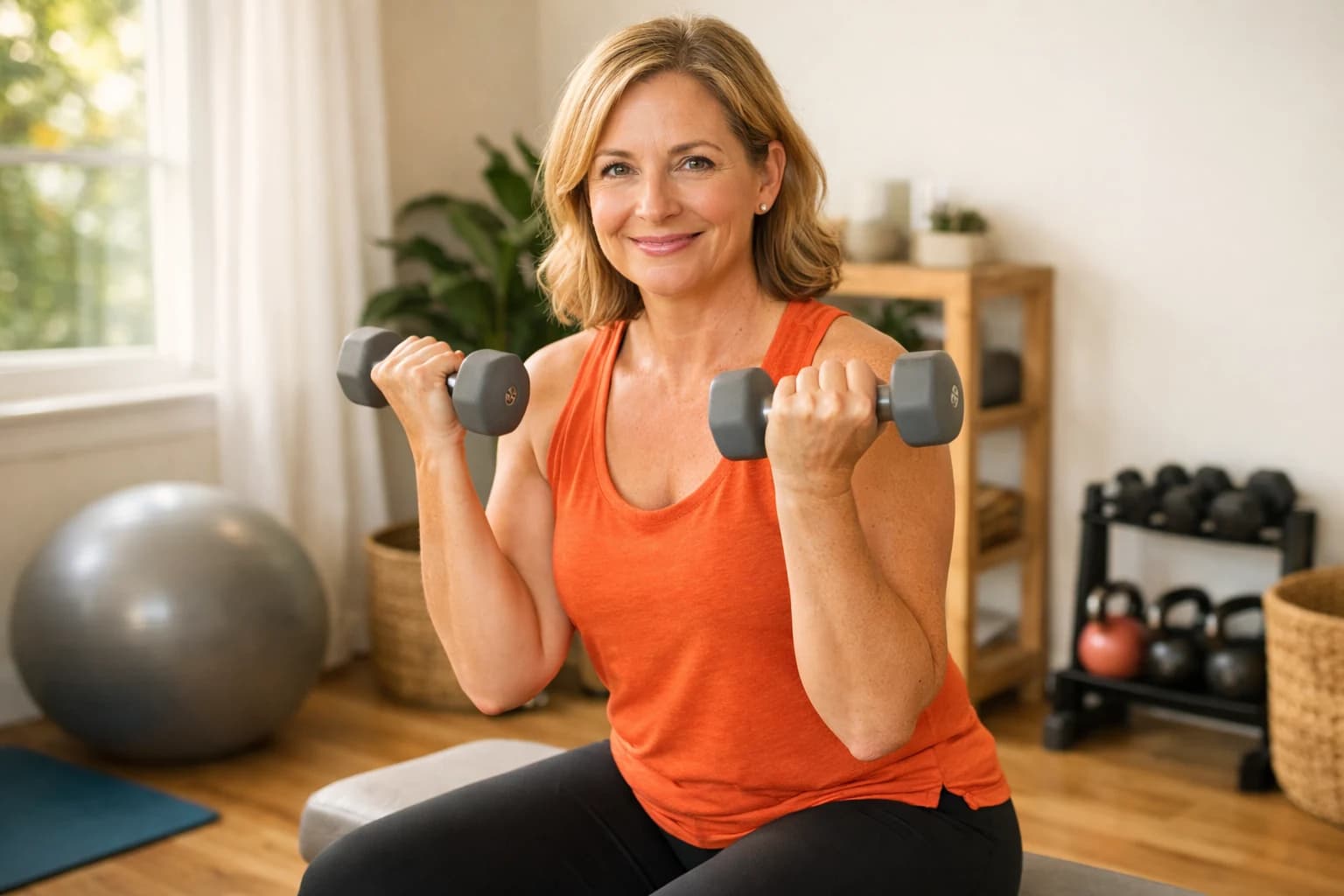
If you are looking up strength training for menopause beginners, there is a decent chance you are not trying to become a bodybuilder. You probably just want your body to feel more like yours again.
Maybe you have noticed softer muscle tone, more belly weight, less energy, or a body that seems to respond differently than it did ten years ago. Maybe your joints feel stiffer, your sleep is lighter, your recovery is slower, and the workouts that used to work now just make you feel drained. Maybe you know strength training matters, but the gym still feels intimidating or you are not sure where to begin.
That is a very normal place to start.
Menopause changes the landscape, but it does not mean you missed your chance to get stronger. In fact, this is one of the most useful times to begin. Strength training helps support muscle, bone density, insulin sensitivity, balance, confidence, and long-term function. It can also be one of the best ways to feel more stable in a season of life that can otherwise feel physically unpredictable.
At Duluth Metabolic, we care about this because menopause is not just a hormone story. It is also a muscle story, a blood sugar story, a recovery story, and a quality-of-life story. For more context, it helps to read menopause metabolic health and hormone optimization, protein requirements over 40, and building bone density after 50.
Why strength training matters more during menopause
As estrogen shifts, a lot of women notice changes in body composition, energy, recovery, sleep, and appetite. Muscle can decline more easily. Bone density becomes more important. Blood sugar often gets less forgiving. That is one reason walking alone, while still helpful, may not fully cover what the body needs now.
Strength training helps because muscle is metabolically active tissue. It improves insulin sensitivity, supports resting metabolism, helps with stability and posture, and gives your body more reserve for everyday life.
It also matters for prevention.
If you are concerned about osteoporosis, weight management, or musculoskeletal weakness, resistance training is one of the best long-term investments you can make.
Beginner mindset first
A lot of women overcomplicate the start because they think they need the perfect plan.
You do not.
You need a repeatable plan, good enough form, and enough patience to let progress build. Menopause beginners do especially well when they stop chasing punishment and start training for function. The goal is not to leave every session exhausted. The goal is to become stronger, steadier, and more resilient over time.
That means your first win is showing up consistently, not crushing yourself.
What counts as strength training during menopause
Strength training simply means asking your muscles to work against resistance.
That resistance can come from:
- bodyweight
- dumbbells
- kettlebells
- resistance bands
- cable machines
- weight machines
- loaded carries and household objects in some situations
For beginners, you do not need fancy equipment. A pair of dumbbells and a resistance band can go a long way. What matters more is choosing useful movements and repeating them often enough to improve.
If you are completely new, functional training for beginners over 40 and resistance band workout for beginners over 40 are great companion reads.
The movements that matter most
You do not need twenty exercises. You need a few patterns done well.
A strong beginner program usually includes:
Squat or sit-to-stand pattern
This trains your legs and helps with getting up from chairs, stairs, hiking, and daily independence.
Examples include bodyweight squats to a box, goblet squats, or sit-to-stands from a bench.
Hinge pattern
This teaches your hips to load properly and helps build glutes, hamstrings, and the back side of your body.
Examples include Romanian deadlifts, kettlebell deadlifts, and hip bridges.
Push pattern
This builds upper-body strength for pushing doors, getting off the floor, and carrying things with less strain.
Examples include incline push-ups, dumbbell chest press, or overhead press when tolerated.
Pull pattern
This supports posture, shoulder health, and upper-back strength.
Examples include rows, band pull-downs, or cable rows.
Carry and core stability
These help balance, trunk control, and real-world function.
Examples include farmer carries, suitcase carries, planks, dead bugs, and bird dogs.
This is one reason exercise as medicine and functional training for beginners over 40 overlap so much in practice.
A simple weekly plan for strength training menopause beginners
You do not need to train every day.
For most beginners, two or three sessions a week is enough.
Option 1: Two-day plan
Day 1
- box squat or goblet squat, 3 sets of 8 to 10
- dumbbell row, 3 sets of 8 to 10
- glute bridge, 3 sets of 10 to 12
- incline push-up or chest press, 3 sets of 8 to 10
- farmer carry, 3 rounds of 20 to 30 seconds
Day 2
- Romanian deadlift, 3 sets of 8 to 10
- step-up or split squat, 3 sets of 8 each side
- band row or cable row, 3 sets of 10
- overhead press or landmine press, 2 to 3 sets of 8
- dead bug or bird dog, 3 sets of 6 to 8 each side
Option 2: Three-day plan
Day 1: lower body and core
Day 2: upper body and carries
Day 3: full body with slightly lighter volume
The exact split matters less than repeating the main patterns and adding a little challenge over time.
How hard should it feel
This is where many beginners either do too little or way too much.
A good working set should feel like you could maybe do one or two more reps with solid form. If you finish every set feeling like you barely did anything, it is probably too light. If your form falls apart and you feel wrecked for four days, it is probably too much.
You want challenge, not chaos.
That usually means starting with moderate loads, learning the movement, and then gradually increasing weight, reps, or control.
What if you have joint pain, fatigue, or feel out of shape
You can still start.
In fact, many menopause beginners should start gentler than their ego wants and more consistently than their all-or-nothing brain expects. A shorter session done twice a week beats a heroic plan that never happens again.
If joints are cranky, use supported variations. If balance is shaky, hold onto something. If fatigue is high, start with fewer exercises. If you are worried about injury, begin with exercise therapy or a coached plan.
Strength training should meet you where you are, not punish you for not being somewhere else.
Nutrition matters more than most beginners realize
Training is the signal. Food is part of the building material.
If you want better results during menopause, protein matters. A lot of women are under-eating protein and then wondering why strength gains are slow and hunger stays high. Recovery also improves when meals are more balanced and blood sugar is steadier.
This is a big reason strength work pairs well with nutrition coaching, blood sugar-friendly breakfast ideas, and high-protein breakfast ideas in Duluth MN.
Strength training helps more than the mirror
Yes, it can help body composition. But for a lot of women, the better wins are less obvious at first.
You may notice:
- getting out of a chair more easily
- carrying groceries with less effort
- feeling more stable on ice, stairs, or trails
- better posture and less achiness
- improved confidence around movement
- better blood sugar response and steadier appetite
That is the kind of progress that tends to matter in real life.
It also supports the bigger work many women are doing around hormone imbalance, perimenopause weight gain and insulin resistance, and long-term metabolic flexibility.
Common mistakes strength training menopause beginners make
One is doing too much cardio and not enough resistance work.
Another is staying with weights that are far too light because lifting feels intimidating. Another is changing workouts every week instead of practicing the same basics long enough to improve. Some women also under-eat, skip recovery, or assume soreness is the goal.
It is not.
The goal is progress.
FAQ about strength training for menopause beginners
Can I start strength training if I have never lifted weights before?
Yes. Plenty of women start in their 40s, 50s, and 60s. You do not need an athletic background to benefit.
Will lifting weights make me bulky?
That is a very common fear, but it is not how this usually goes. Most beginners notice better muscle tone, posture, and strength long before anything resembling bulk.
How many days a week should I lift during menopause?
Two to three days a week is a strong starting point for most beginners.
Is walking enough during menopause?
Walking is excellent, but it usually works best alongside some form of strength training if your goal is muscle, bone support, metabolic health, and long-term function.
What if I am also trying to lose weight?
Strength training still helps. It supports muscle retention, improves insulin sensitivity, and often makes weight loss efforts more sustainable than cardio-only plans.
Start where you are, then keep going
Strength training for menopause beginners does not have to be fancy. It needs to be safe, challenging enough, and consistent. That is where the real change happens.
If you want help building a plan that fits your energy, joints, schedule, and metabolic goals, contact Duluth Metabolic. We can help you put together a practical next step that actually feels doable.