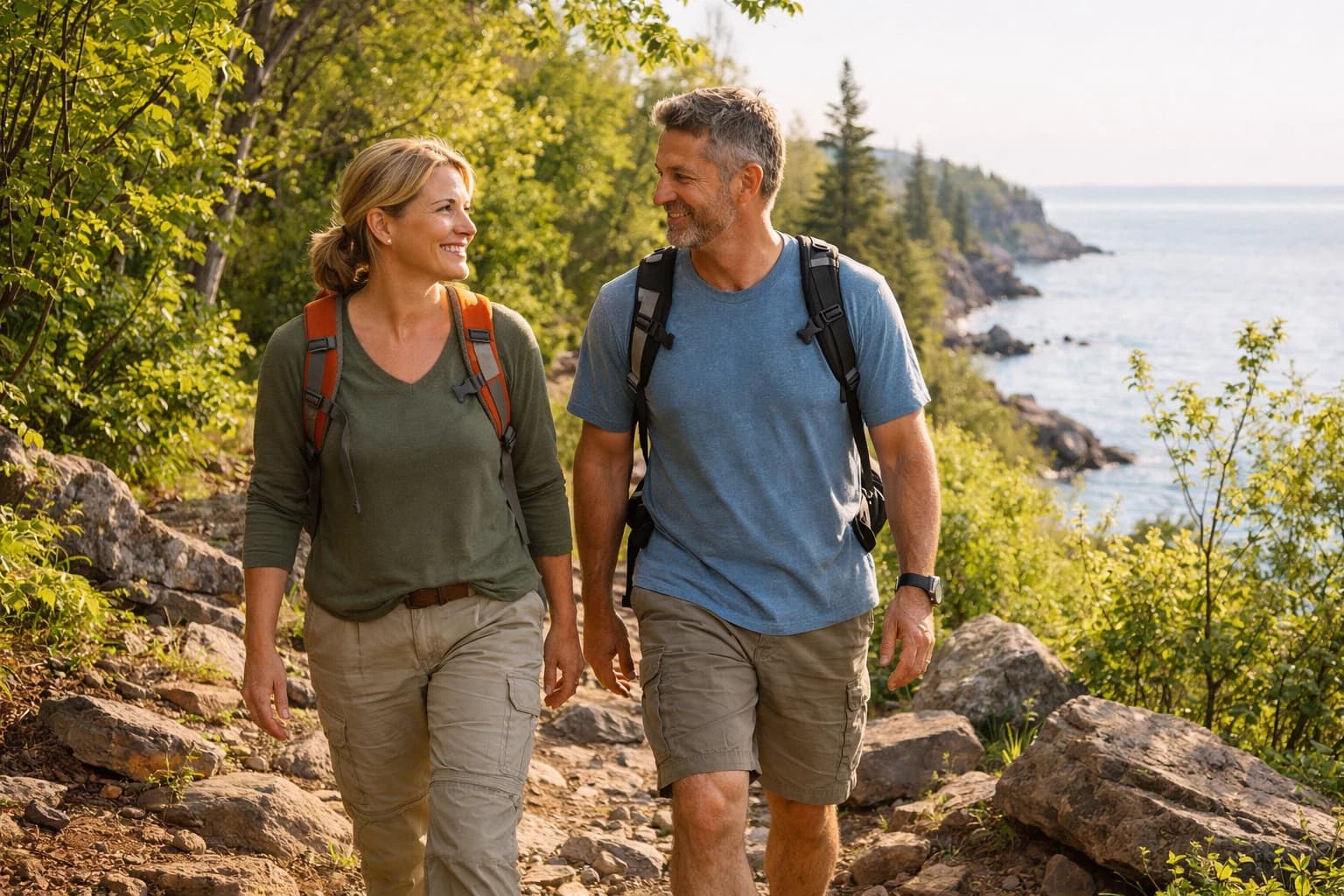
Looking for hiking training over 40 in Duluth, MN usually means one thing. You want to enjoy the trail more, but your body is giving you a little less margin than it used to.
Maybe your lungs feel fine, but your knees start talking on descents. Maybe your balance feels shakier on roots and rocks. Maybe the first real hike of spring reminds you that winter sitting adds up. Or maybe you want to explore more of Duluth without feeling wrecked the next day.
That is a very normal place to start.
At Duluth Metabolic, we think hiking fitness after 40 should make life feel bigger, not more fragile. The goal is not to train like a mountain athlete with unlimited free time. The goal is to build enough strength, balance, and endurance that local trails feel fun again.
If this is your season to get moving, also check out outdoor fitness in Duluth, train for hiking in Duluth, MN, zone 2 training for beginners over 40, and mobility exercises over 40 in Duluth, MN.
Why hiking feels different after 40
A lot of adults blame age in a vague way, but the changes are usually more specific than that.
You may have:
- a little less muscle than you used to
- less single-leg stability
- less ankle mobility
- lower tolerance for repeated downhill impact
- less aerobic base than you think
- slower recovery if sleep and stress are off
That does not mean you should stop hiking. It means your body responds better when you train on purpose.
This matters even more if you are dealing with musculoskeletal weakness, chronic fatigue, or osteoporosis. The right kind of preparation can improve confidence, reduce soreness, and make the trail feel more accessible.
What hiking training over 40 in Duluth, MN should focus on
Most people do not need a complicated hiking program. They need a simple one that covers the demands of real local trails.
In Duluth, that usually means:
- climbing short steep hills
- walking uneven ground
- stepping over roots and rocks
- descending without your knees hating you
- carrying a small pack or water bottle comfortably
- moving long enough to actually enjoy the day
That points us toward five big priorities.
1. Leg strength for climbing and descending
Uphill hiking asks for strength. Downhill hiking asks for control.
That is why hiking training over 40 should include more than walking. If you never build leg strength, local trails can feel much harder than the mileage suggests.
The most helpful exercises are usually simple:
- step-ups
- split squats or supported lunges
- squats to a box or bench
- deadlifts or hip hinges
- calf raises
You do not need fancy gym work to make progress. A stair, a bench, resistance bands, dumbbells, or bodyweight can go a long way.
If you are newer to this, functional training for beginners over 40 and resistance band workout for beginners over 40 are good starting points.
2. Balance and single-leg stability
A lot of trail confidence comes down to one thing. Can you support yourself well on one leg when the ground is not perfect?
That is why balance matters so much for hikers over 40.
Good drills include:
- standing on one leg
- toe taps in different directions
- step-downs
- suitcase carries
- controlled single-leg hinges with support if needed
These are not flashy, but they matter. Better balance can mean fewer missteps, less wasted energy, and more confidence on rocky trails.
3. Aerobic base so every hill does not feel personal
A lot of people think they need brutal intervals to get hiking-ready. Usually they do not.
Steady aerobic work helps more.
That can look like:
- brisk walking
- incline treadmill walking
- cycling
- rowing
- easy rucking if you already tolerate it well
This is where zone 2 training for beginners over 40 fits beautifully. It builds endurance without beating you up, which makes it much easier to stay consistent.
4. Mobility where it actually matters
You do not need an hour of stretching every night. You do need enough mobility to move well.
For hikers, the biggest priorities are often:
- ankles that can bend well enough for hills and stairs
- hips that allow a normal stride
- thoracic mobility for posture and breathing
- calves that are not constantly tight
A short routine done a few times per week usually beats a heroic mobility session you never repeat.
5. Recovery that keeps the plan going
This is where a lot of adults over 40 get tripped up. They train hard once, get sore, decide hiking fitness is not realistic, then stop for a week.
A better plan is one you recover from.
That means:
- building gradually
- sleeping enough
- eating enough protein
- taking easy days seriously
- keeping strength work challenging but not punishing
If soreness and inflammation are common for you, recovery guide in Duluth and protein requirements over 40 are worth reading too.
A practical weekly hiking training plan over 40
If you want something simple, this works well for many busy adults.
Day 1: Strength training
Focus on legs, hips, and core.
A sample session:
- step-ups, 3 sets
- goblet squat or sit-to-stand, 3 sets
- supported split squat, 2 to 3 sets
- calf raises, 2 to 3 sets
- front plank or dead bug, 2 to 3 sets
Day 2: Brisk walk or zone 2 cardio
Aim for 25 to 40 minutes at a conversational pace.
Day 3: Mobility and easy walking
Keep it light. Think of this as recovery that still moves you forward.
Day 4: Strength training
Use many of the same movement patterns, but you can swap in deadlifts, band rows, carries, and step-downs.
Day 5: Outdoor walk or hill session
Find a route with some elevation or use a treadmill incline. You do not need to crush yourself. You just need practice.
Weekend: Hike, longer walk, or trail time
This is where the plan turns into real life. Start with easier local routes and build duration before chasing difficulty.
This kind of week pairs nicely with 20-minute workouts for busy adults over 40 if time is tight.
How to use Duluth trails as your training ground
One of the nice things about living here is that you do not need a special destination to practice hiking fitness. Duluth itself gives you plenty of terrain.
Depending on your current level, you can use:
- neighborhood hills for short climbing efforts
- the Lakewalk for steady aerobic work
- easier trails for footing and rhythm
- stair work or incline treadmills when weather is rough
- parks and mixed-terrain routes to build confidence
You do not need every session to happen on the trail. But using local hills and uneven ground once in a while helps bridge the gap between gym fitness and actual hiking.
What to do if downhill hiking is your biggest problem
This is one of the most common complaints after 40.
Going up is hard, but going down is where knees, quads, and confidence often fall apart.
That is usually a sign to train eccentric control, which is your ability to control lowering.
Helpful exercises include:
- step-downs
- slow split squats
- reverse lunges
- controlled box squats
- downhill treadmill walking at a modest dose if available
Poles can help too, especially on longer descents. There is no shame in using tools that make hiking more enjoyable.
What to eat before and after hiking
Fuel matters more than people think, especially if you tend to bonk, overheat, or get very sore.
Before a hike, many adults do well with a light meal or snack that includes protein and some carbohydrate. Think yogurt and fruit, eggs and toast, or a protein shake and a banana depending on timing.
After a hike, focus on hydration and protein. That can be a normal meal. It does not need to be a special sports product.
If you want more practical food ideas, high-protein breakfast ideas in Duluth, MN, best protein snacks for blood sugar control, and what to eat before strength training over 40 can help.
Hiking training over 40 in Duluth, MN for beginners
If you are starting from zero, keep the bar lower than your motivation wants it to be.
That may mean:
- two short strength sessions per week
- two or three walks
- one easy local trail outing
- no heroic workouts
This is especially important if you are coming back after illness, pain, a long winter, or a stretch of very little exercise. The first goal is consistency.
Not proving something.
Signs your training plan is working
People often miss progress because they are only looking for dramatic changes.
Watch for:
- hills feel less intimidating
- recovery between hikes gets better
- your knees complain less on descents
- you can carry water or a daypack more comfortably
- your pace improves without trying to push it
- you feel more stable on uneven ground
Those are real wins.
When to slow down and get support
A training plan should challenge you, but it should not keep flaring you up.
It makes sense to get help if:
- knee or hip pain is getting worse
- fatigue feels out of proportion to the work
- balance feels unsafe
- you avoid trails because you do not trust your body
- every hike turns into a recovery project
That is where exercise therapy can be useful. The goal is not to turn you into an athlete. It is to help you move better, get stronger, and stay active long term.
FAQ about hiking training over 40 in Duluth, MN
How do I train for hiking after 40?
Start with two strength sessions per week, two to three aerobic sessions, and one easy hike or hill session. Focus on legs, balance, endurance, and gradual progression.
What exercises are best for hiking over 40?
Step-ups, split squats, squats, hinges, calf raises, step-downs, and single-leg balance work are some of the most useful exercises because they match real trail demands.
Is walking enough to train for hiking?
Walking helps a lot, especially for endurance, but most people do better when they add strength work and some hill or incline practice.
How can I make hiking easier on my knees?
Build leg strength, train step-down control, progress slowly, and consider poles on tougher descents. Recovery and footwear matter too.
How often should I hike to get better?
Even one hike or trail session per week can help if you support it with strength work and steady aerobic training during the week.
If you want to enjoy Duluth trails with more confidence and less wear-and-tear, Duluth Metabolic can help you build a plan that fits your body and your schedule. Through exercise therapy, nutrition coaching, and practical metabolic support, we help adults train for the life they actually want to live. Reach out through /contact when you are ready.